Let AI Find the Gaps You Didn't Know You Had
Before you open the book, put an LLM to work as a study partner. A simple prompt to surface your blind spots, organize your questions into topics, and build a learning path you can actually follow.
When I sit down to study something new, my old instinct was to just start reading and hope it sticks. These days I do something different: I put the AI to work as a study partner before I even open the book. Not to do the learning for me — to help me aim.
Here's the workflow, and a prompt you can copy and use today.
Your questions cover what you know you don't know
Start with the questions you already have — the things you know you want to understand. That list is useful, but it has a built-in blind spot: it only covers what you already know you're missing. The most dangerous gaps are the ones you can't see — the questions you don't even know to ask.
That's exactly where an LLM like Claude, Gemini, or ChatGPT earns its keep. Paste in your questions and ask it one simple thing: what am I missing? Almost every time, it surfaces angles you hadn't considered. Your own questions map what you know you don't know. The AI helps you see what you don't know you don't know.
A messy pile becomes a map
Once the gaps are on the table, ask the AI to organize them: take every question and split it into topics. A scattered list turns into a structured map — and a map is something you can actually work through.
Then go one step further and ask it to build a learning path: what to understand first, what builds on what, where to spend the most time. Sequencing matters, because most subjects are a ladder — the hard concepts only make sense once the foundational ones are solid.
The prompt
Here's the whole thing in one reusable prompt. Swap in your subject and your starting questions:
I'm trying to learn [TOPIC]. Here are the questions I currently have:

[PASTE YOUR QUESTIONS — one per line, however rough]

Do three things for me:
1. Gaps: What important questions am I NOT asking that I should be?
   What are the blind spots or misconceptions beginners usually have here?
2. Topics: Take my questions plus the ones you added and group them
   into a handful of clear topics.
3. Learning path: Order those topics from first to last — what to
   understand before what, and where I should spend the most time.

Don't explain the answers yet. I want the map, not the lecture —
I'll do the actual learning myself.
That last line matters. You want the scaffold — the gaps, the topics, the order — not the answers handed to you. The moment the AI explains everything, you're back to passive reading, and reading is not the same as learning.
The AI aims; you still have to shoot
The key thing I keep reminding myself: the AI isn't there to do the learning for me. It generates the scaffold. I still have to do the real work — understanding each topic, then testing whether I can actually recall it. That second half is non-negotiable. Decades of learning research keep landing on the same conclusion: durable memory comes from pulling information out of your head, not reading it back in.
So the full loop looks like this:
- Aim — use the prompt above to turn "I want to learn X" into a concrete map of topics and an order to tackle them.
- Learn — work through the path, one topic at a time, from your real sources.
- Generate — after each topic, close the tab and quiz yourself. Turn it into questions, flashcards, a summary in your own words. If you can't produce it, you haven't learned it yet.
From map to quiz in one step
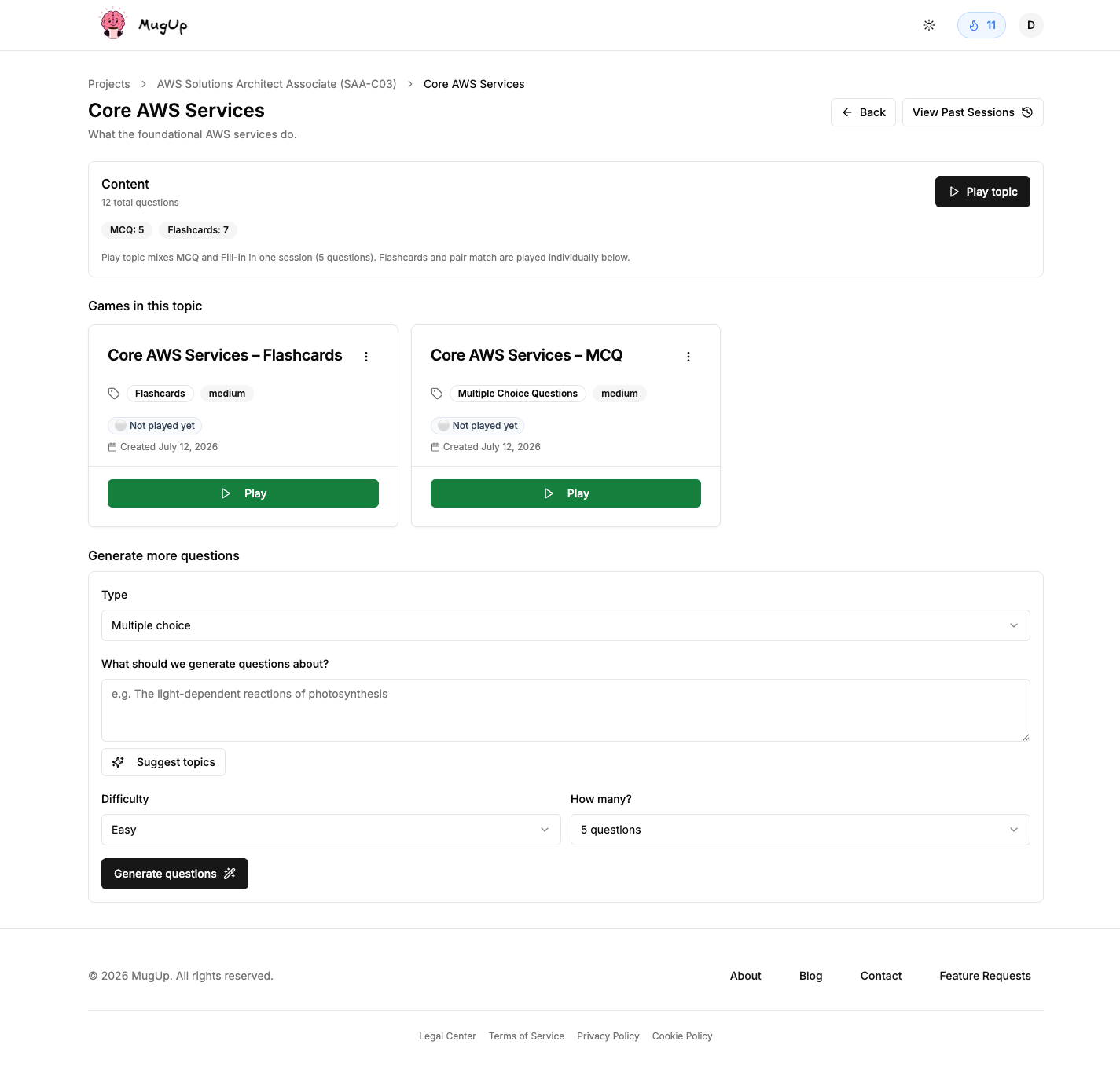
Step three is where MugUp comes in. Once the AI has handed you a clean list of topics, drop any of them into MugUp and it instantly builds quizzes, flashcards, fill-in-the-blanks, and matching games — so the plan you just made turns straight into practice, no card-making required.
Start free and turn your first topic into a study game today.
The takeaway
If you've never tried this, start small. Take one thing you're trying to learn, dump your current questions into an LLM, and ask it what you're missing. Let it organize the mess and sequence the path. Then close the chat and do the part only you can do — the understanding and the recall. You might be surprised how much sharper your study session gets.
More on the "do the recall yourself" half: stop re-reading, start generating and why quizzing yourself helps you remember more.
Turn this into a game
Type a topic and MugUp's AI builds quizzes, flashcards, and matching games in seconds. Free to start.